Successful business events create opportunities to meet potential customers, strengthen relationships, and introduce people to your brand. But once attendees leave the venue, maintaining that connection can be challenging. Well-chosen promotional merchandise gives people something useful to take with them and a reason to remember the organization behind it.
Choosing the right promotional products for events involves more than placing a company logo on inexpensive merchandise. The products should fit the audience, support the event’s objectives, reflect the company’s identity, and arrive ready for distribution.
For marketing managers, event planners, procurement teams, and business owners, understanding these decisions can make promotional merchandise a more purposeful part of event planning.
What Are Promotional Products for Events?
Promotional products for events are customized items distributed to attendees, employees, prospects, or business partners during organized gatherings. They typically feature a company name, logo, campaign message, or event-specific design.
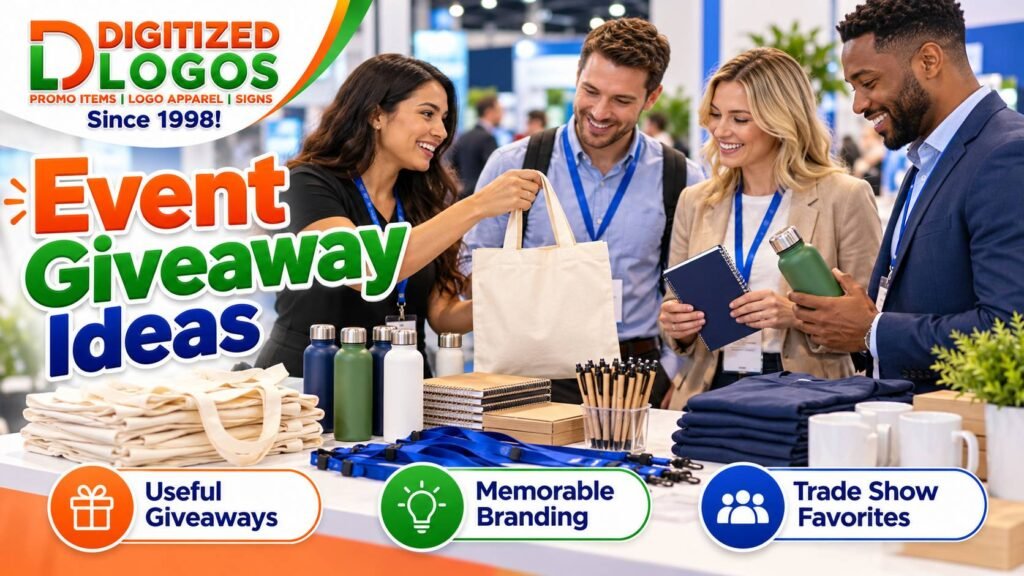
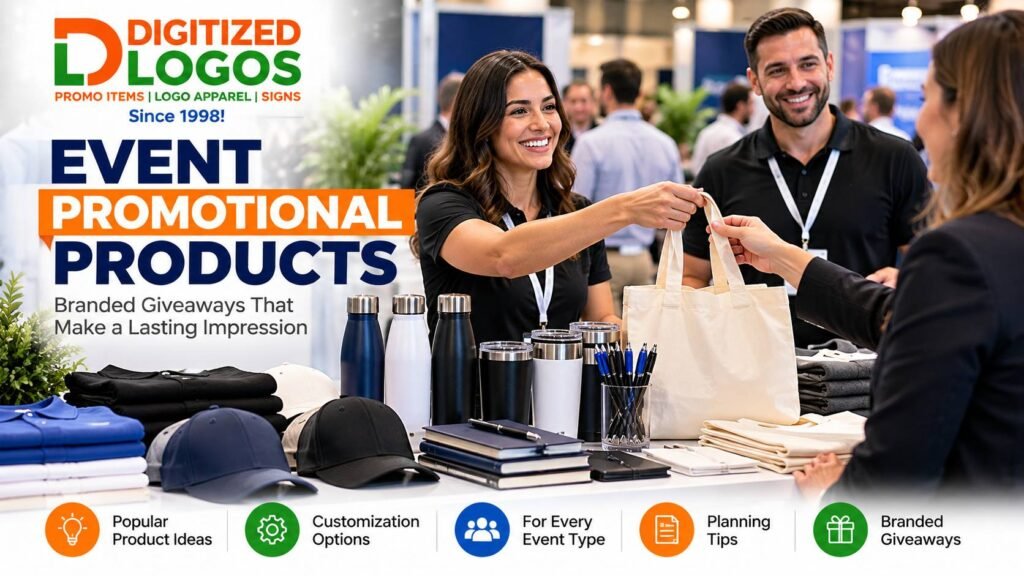
Common examples include branded tote bags, reusable drinkware, notebooks, pens, T-shirts, polo shirts, lanyards, and technology accessories. Businesses use these products at trade shows, conferences, corporate meetings, recruiting events, product launches, employee celebrations, and community programs.
Their primary purpose is to create a useful, tangible connection between the recipient and the sponsoring organization. Their value depends on how closely the product matches the recipient’s needs and how effectively it supports the event’s broader objectives.
Why Do Businesses Use Promotional Products at Events?
Branded merchandise serves several business purposes, but its effectiveness depends on thoughtful selection and distribution.
Build Brand Recognition Beyond the Event
An attendee might encounter dozens of companies during a trade show. A useful branded notebook, water bottle, or tote bag can provide an additional reminder of one particular organization after the event ends.
Repeated exposure is possible when recipients continue using the merchandise. However, logo visibility alone does not establish measurable brand awareness or generate qualified leads. The product must contribute to a broader marketing experience.
Encourage Engagement at Exhibition Booths
Promotional giveaways can help start conversations with visitors who might otherwise pass an exhibition booth.
Rather than distributing items without interaction, booth representatives can introduce their company’s services, ask relevant qualifying questions, and offer merchandise that complements the discussion.
Recognize Employees and Business Partners
Not every event giveaway needs to support customer acquisition. Employee appreciation events, annual meetings, leadership retreats, and partner conferences often use branded gifts to recognize participation and reinforce a shared organizational identity.
For these situations, thoughtful presentation, practical value, and product quality may matter more than distributing the highest possible quantity.
Create a Consistent Event Experience
Branded apparel, lanyards, tote bags, table covers, and attendee gifts can bring visual consistency to an event. Coordinating these products with the company’s established colors and artwork helps visitors identify staff members, recognize booth branding, and connect different elements of the event experience.
Best Promotional Products for Different Types of Events
There is no universally suitable giveaway. The most appropriate products depend on the audience, event format, budget, transportation requirements, and intended use.
1. Trade Shows and Industry Expos
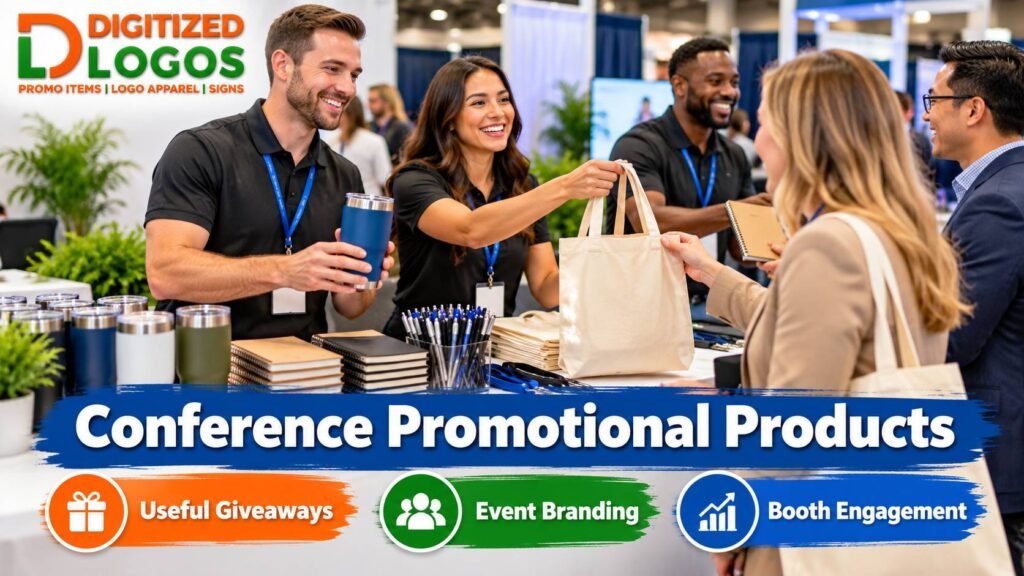
Trade shows often involve busy exhibition floors, limited booth space, and attendees collecting materials from multiple vendors. Compact products that are easy to distribute and transport generally make practical choices.
- Branded tote bags: Useful for carrying brochures, catalogs, and other materials collected during the event.
- Custom pens: Compact, familiar, and suitable for broad distribution.
- Promotional notebooks: Relevant for attendees who take notes during sessions and vendor meetings.
- Reusable water bottles: Practical gifts when recipients can conveniently carry them.
- Custom lanyards: Useful when coordinated with event badge requirements.
For a large exhibition, businesses may choose a practical giveaway for general visitors and reserve a smaller quantity of higher-value gifts for scheduled meetings with qualified prospects.
2. Corporate Conferences and Business Meetings
Conferences typically involve professional networking, educational sessions, and extended periods of participation. Products that support the conference experience are particularly relevant.
Consider customized notebooks, insulated tumblers, document folders, premium pens, and branded apparel. These products can complement welcome packages or be distributed during registration.
For executive-level gatherings, a coordinated merchandise kit may provide a more appropriate experience than several unrelated items.
3. Employee Appreciation and Team-Building Events
Employee-focused merchandise should emphasize comfort, usefulness, and a sense of belonging.
Popular options include custom T-shirts, embroidered polo shirts, jackets, reusable drinkware, backpacks, and desk accessories.
Apparel requires additional planning because employees have different sizing and fit preferences. Collecting size information before production can reduce the risk of unsuitable garments and unnecessary replacements.
4. Product Launches and Brand Activations
A product launch offers an opportunity to connect promotional merchandise with a specific campaign.
Custom apparel, reusable bags, stickers, drinkware, and carefully selected merchandise kits can carry launch artwork or campaign messaging.
The design should reinforce the product story rather than simply adding as much advertising copy as possible. A memorable visual concept can often communicate more effectively than an overcrowded decoration area.
5. Community Events and Outdoor Gatherings
Outdoor events introduce practical considerations such as weather, portability, audience diversity, and distribution speed.
Depending on the setting, suitable products may include branded caps, reusable bottles, sunglasses, tote bags, and lightweight T-shirts.
Product selection should reflect the expected activities. An outdoor volunteer program may benefit from coordinated apparel, while a community information fair may call for accessible giveaways that appeal to a wide audience.
How to Choose the Right Branded Products for Events
Buying branded products for events becomes easier when the selection process starts with business objectives rather than product catalogs.
- Define the event objective. Determine whether merchandise should encourage booth engagement, support lead generation, recognize employees, welcome participants, or strengthen existing relationships.
- Understand the audience. Consider attendee demographics, professional interests, expected activities, travel requirements, and how recipients might use the product afterward.
- Establish a complete budget. Account for product costs, customization, artwork preparation, setup charges where applicable, packaging, shipping, and distribution.
- Choose an appropriate product tier. Decide whether broad-distribution merchandise, selective premium gifts, or a combination better supports the event.
- Review decoration requirements. Confirm that the selected product can reproduce the artwork clearly using a suitable printing or embroidery method.
- Plan the production schedule. Include time for product selection, artwork approval, potential sampling, production, delivery, and shipment inspection.
- Organize distribution. Determine who receives each product, how inventory will be managed, and how the giveaway connects to the attendee experience.
This process helps prevent a common purchasing mistake: selecting merchandise because it looks appealing in a catalog without considering how it will perform at the actual event.
Comparing Promotional Product Categories
Different merchandise categories serve different purposes. A useful comparison considers function, portability, customization, and distribution requirements.
Branded Apparel
Custom T-shirts, polo shirts, jackets, and other garments can support staff identification, event recognition, and employee programs.
Apparel offers a relatively large decoration area, but introduces size distribution, fabric selection, fit, and care considerations. Ordering without reliable size information can create unnecessary inventory problems.
Drinkware
Water bottles, travel mugs, and tumblers are relevant to workplace, conference, employee appreciation, and wellness-related events.
Buyers should compare capacity, materials, lid construction, cleaning requirements, and decoration methods. Packaging and shipping weight also deserve attention, particularly for larger orders.
Bags and Totes
Tote bags, backpacks, and drawstring bags combine everyday function with visible branding opportunities.
For trade shows, consider whether the bag can comfortably accommodate the materials attendees are likely to collect. Handle strength, fabric construction, print area, and carrying comfort are more meaningful than appearance alone.
Office and Writing Products
Pens, notebooks, journals, and related desk accessories are familiar choices for professional events.
Although many are straightforward to distribute, buyers should still evaluate usability, writing performance, paper quality, and decoration legibility.
Technology Accessories
Charging cables, phone stands, and other technology-related items can be useful for professional audiences.
Compatibility, safety documentation, connector types, electrical specifications, and packaging requirements should be reviewed before ordering. A visually appealing accessory is not necessarily appropriate for every recipient’s devices.
Which Customization Method Is Best for Event Merchandise?
The best decoration method depends on the product’s material, artwork complexity, intended appearance, order specifications, and supplier capabilities.
Screen Printing
Screen printing is commonly used for T-shirts, tote bags, and other fabric products. It can be suitable for designs with clearly defined colors, although setup requirements and economics vary by order.
Embroidery
Embroidery creates designs using stitched thread and is frequently chosen for polo shirts, jackets, caps, and professional uniforms.
Fine text, intricate details, and very small decorative elements may require simplification to maintain clarity.
Dye Sublimation
Dye sublimation uses heat to transfer specialized dye into compatible materials. It is particularly relevant to polyester apparel and appropriately coated promotional products.
For event merchandise featuring detailed graphics, gradients, or large areas of color, full-color dye sublimation can offer useful design flexibility.
However, sublimation is not appropriate for every fabric or product surface. Material compatibility, garment construction, artwork placement, and production requirements should be confirmed before selecting this method.
Digital Printing and Other Methods
Depending on the product, digital printing, heat transfers, laser engraving, pad printing, or other techniques may be appropriate.
The decision should be based on how well the method matches the material, design, expected handling, and approved product specifications.
What Buyers Should Know About Artwork and Production
One of the most overlooked parts of ordering custom merchandise is preparing artwork correctly.
A logo that looks sharp on a computer screen may not reproduce clearly on a textured bag, small pen barrel, embroidered cap, or curved tumbler. Production artwork must account for the decoration area’s dimensions, printing limitations, and the selected item’s physical characteristics.
Where available, vector artwork is useful because it can be scaled without the same resolution limitations as raster images. Some full-color designs may require high-resolution raster files instead, depending on the process.
Before approving an order, businesses should review:
- Correct logo version and brand colors.
- Artwork dimensions and placement.
- Minimum readable text size.
- Color reproduction limitations.
- Approved digital proofs or physical samples, when appropriate.
- Garment sizing and decoration consistency.
- Packaging, delivery address, and event deadlines.
Practical production insight: A design proof confirms the proposed layout, but it may not fully represent the appearance of a finished product. Fabric texture, printing processes, thread colors, and product surfaces can affect the final result. For visually sensitive or substantial orders, discussing physical samples with the supplier may reduce uncertainty.
How Much Should Businesses Budget for Event Giveaways?
The total budget for promotional merchandise depends on product selection, quantity, decoration, packaging, transportation, and other order-specific requirements.
A useful starting point is to separate the overall merchandise budget from the planned number of recipients. This helps establish a target cost per distributed item before comparing suppliers.
Consider a hypothetical trade show where a business plans to distribute 500 giveaways and allocates $2,500 for the merchandise program.
The average available budget is $5 per planned giveaway before accounting for costs that may not be included in the quoted unit price.
If packaging, shipping, setup charges, or taxes apply, those expenses must be included when deciding which products are affordable.
Another approach is to use separate budgets for general giveaways and premium gifts. For example, a company might purchase accessible merchandise for regular booth traffic while reserving higher-value items for scheduled customer or prospect meetings.
Neither approach guarantees a financial return. The most appropriate spending level depends on the intended audience, potential business value, event objectives, and available resources.
How Far in Advance Should You Order Promotional Products?
Businesses should begin planning promotional merchandise as early as their event schedule allows. There is no single production timeline that applies to every item or customization process.
Lead times may change based on product availability, manufacturing requirements, artwork revisions, order quantity, supplier workload, shipping destination, and customization complexity.
Imported products, unusual materials, custom packaging, and elaborate designs may introduce additional dependencies.
For time-sensitive events, confirm the supplier’s current production and shipping estimates before committing to an order. The requested delivery date should allow time for inspection and resolving discrepancies before distribution begins.
Two Practical Examples of Event Merchandise Planning
Example 1: A Technology Company Attending an Industry Trade Show
Imagine a technology company exhibiting at a conference where its representatives want to introduce software solutions to corporate buyers.
Instead of purchasing one expensive giveaway for every passerby, the company selects branded pens and notebooks for general conversations. It also prepares a limited quantity of higher-value merchandise for visitors who participate in scheduled product demonstrations.
The promotional merchandise supports a defined engagement process rather than functioning as the primary reason for visiting the booth.
This is a hypothetical example illustrating a possible distribution strategy, not a documented customer result.
Example 2: A Hospitality Group Organizing an Employee Event
Consider a restaurant group hosting an annual employee recognition gathering across several locations.
The company chooses customized polo shirts and reusable tumblers featuring coordinated branding. Employees provide garment sizes before ordering, and the organizer confirms artwork placement to maintain consistency.
The purchasing team also organizes merchandise by location to simplify event distribution.
In this situation, product usefulness, fit, branding consistency, and fulfillment planning are more important than maximizing the number of individual giveaways.
This example is hypothetical and does not represent a specific Digitized Logos customer engagement.
Common Mistakes to Avoid When Ordering Event Merchandise
Many promotional product problems begin before production. Recognizing potential issues early can help businesses make more confident purchasing decisions.
- Choosing products based only on price: An inexpensive item may provide limited value if recipients have little reason to use it.
- Ignoring audience preferences: Merchandise should suit the people attending the event, not simply reflect the organizer’s personal preferences.
- Overcrowding the artwork: Too much text can reduce readability and weaken the design.
- Ordering apparel without size planning: Incorrect size distribution can leave employees or attendees without suitable garments.
- Overlooking shipping requirements: Bulky or heavy merchandise may introduce logistical costs and storage challenges.
- Approving artwork without careful review: Small spelling mistakes or outdated logos can affect an entire customized order.
- Ordering too close to the event: Limited time can reduce product options and leave little room for correcting problems.
- Failing to plan distribution: Even appropriate merchandise can be wasted when quantities, recipient groups, and booth procedures are not considered.
How to Measure the Effectiveness of Promotional Products at Events
Measuring giveaway performance requires connecting merchandise distribution with specific event objectives.
For a trade show, relevant indicators may include booth conversations, qualified leads, scheduled demonstrations, and post-event sales opportunities.
For an employee program, organizers might evaluate participation, product acceptance, sizing accuracy, and employee feedback.
Possible measurement methods include:
- Tracking the number of products distributed.
- Recording qualified conversations associated with giveaway campaigns.
- Using dedicated campaign landing pages or QR codes when appropriate.
- Comparing merchandise expenses with the overall event budget.
- Reviewing attendee or employee feedback.
- Monitoring resulting business opportunities through existing sales processes.
QR code scans or giveaway redemptions can indicate engagement, but they do not automatically prove that merchandise caused a sale. Businesses should distinguish observable activity from outcomes that require stronger attribution evidence.
How to Select a Promotional Merchandise Supplier
A dependable supplier should help buyers understand the available products, decoration options, artwork requirements, production constraints, and order logistics.
When evaluating potential vendors, ask how they handle artwork approvals, order changes, product substitutions, packaging, delivery coordination, and quality concerns.
It is also worth confirming whether the supplier can accommodate multiple merchandise categories under a coordinated purchasing process.
Digitized Logos provides branded apparel and promotional product solutions for business customers. Companies exploring promotional products for events can review merchandise options and discuss product selection, customization, and fulfillment requirements based on their event plans.
Frequently Asked Questions About Event Promotional Products
What are the most useful promotional products for events?
Useful options commonly include tote bags, reusable drinkware, notebooks, pens, and branded apparel. The most suitable choice depends on the event format and attendee needs. For example, notebooks may complement educational conferences, while tote bags can help trade show visitors carry materials collected throughout the exhibition.
Are expensive promotional giveaways better than inexpensive ones?
Not necessarily. A higher-priced product may be appropriate for employee recognition or select client gifts, but a practical, lower-cost item may work well for broad distribution. Businesses should compare product usefulness, recipient relevance, decoration quality, total cost, and intended purpose instead of assuming that price determines effectiveness.
Can promotional products be customized with full-color designs?
Yes. Many promotional items support full-color artwork, although available methods depend on the product material and decoration surface. Dye sublimation is one option for compatible polyester apparel and specially coated products. Buyers should confirm artwork specifications and production capabilities before approving a complex design.
How many promotional products should I order for an event?
Order quantity should reflect expected attendance, distribution goals, staffing plans, and budget. Not every attendee will necessarily visit your booth or qualify for a premium gift. Using separate quantity estimates for general giveaways, staff merchandise, and selected prospects can make ordering more accurate.
Can one supplier provide several types of branded event merchandise?
Some promotional product suppliers offer multiple categories, including apparel, bags, drinkware, and office accessories. Consolidating purchasing may simplify communication and artwork coordination, but buyers should confirm product availability, decoration capabilities, individual production schedules, and shipping requirements before placing a combined order.
Key Takeaways for Planning Event Promotional Merchandise
- Choose event merchandise based on audience needs and defined business objectives.
- Prioritize usefulness, appropriate customization, and product quality over giveaway quantity alone.
- Include decoration, packaging, shipping, and other applicable charges when evaluating the total budget.
- Review artwork, materials, production requirements, and delivery schedules before ordering.
- Connect distribution to measurable event activities rather than treating merchandise as a standalone marketing strategy.
Plan Your Next Event with Digitized Logos
The right promotional merchandise should make sense for your audience, your event, and your business objectives. A coordinated approach to product selection, artwork, budgeting, and delivery helps reduce purchasing uncertainty while creating a more consistent brand experience.
Digitized Logos helps businesses explore branded apparel and custom merchandise options for corporate gatherings, trade shows, conferences, employee programs, and other organized events.
Explore promotional products for events to find merchandise that aligns with your requirements, or contact Digitized Logos to discuss your project.
Phone: 301-963-3553
Email: info@DigitizedLogos.com
Share your event date, estimated quantity, preferred products, artwork needs, and delivery location to begin evaluating suitable options.