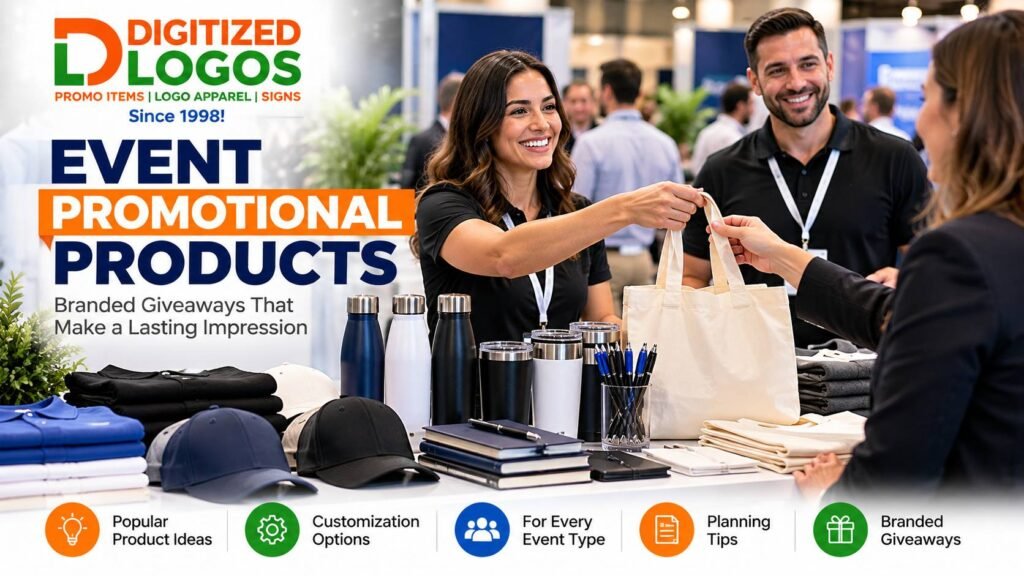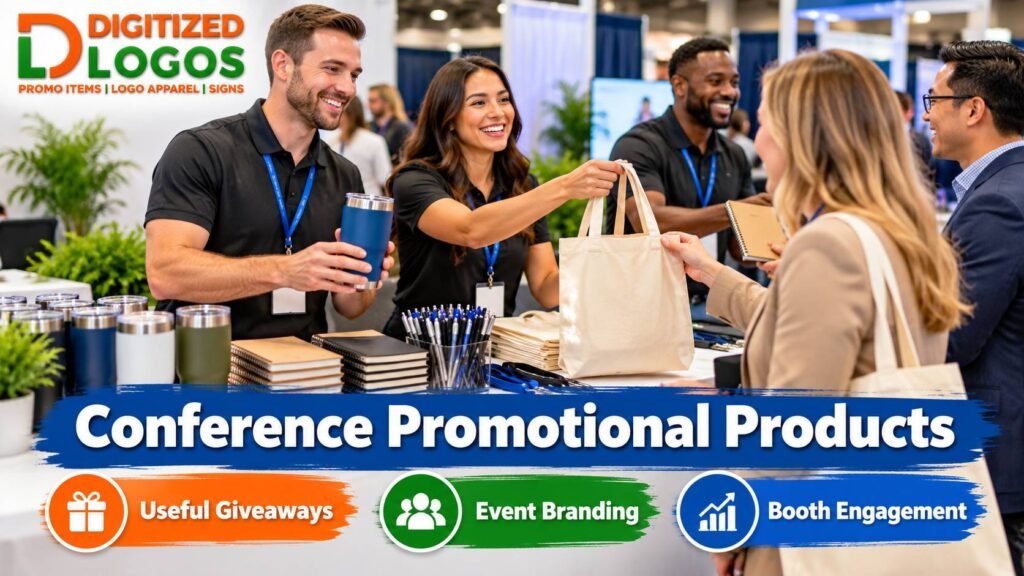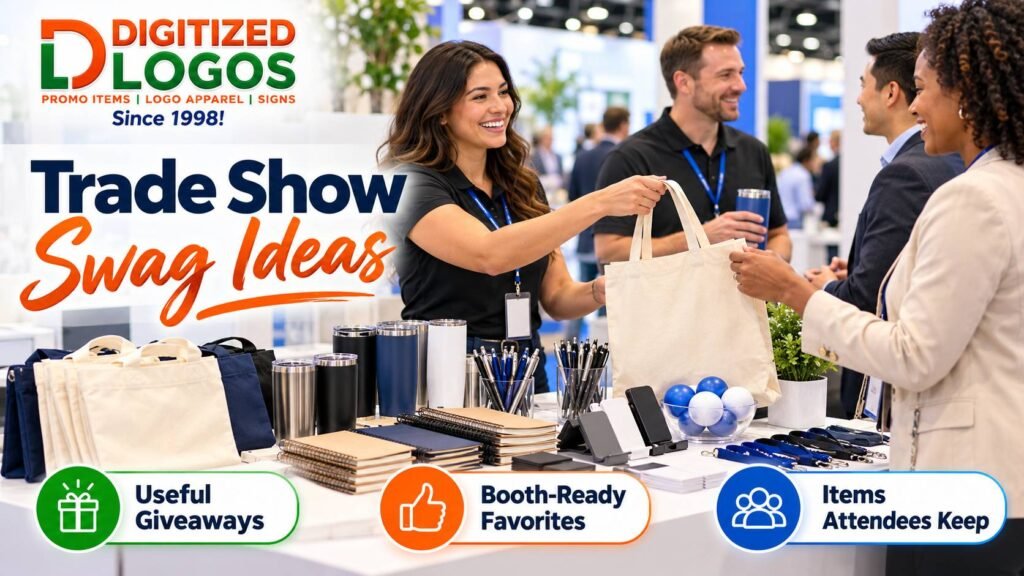
The right event giveaway ideas can help businesses start conversations, create a more memorable attendee experience, and keep their branding visible after an event ends. From practical everyday accessories to premium custom apparel, successful giveaways offer something attendees have a genuine reason to use.
Choosing promotional merchandise involves more than placing a logo on an inexpensive product. Event organizers must consider their audience, budget, branding, distribution strategy, and production timeline. Exploring event giveaway ideas with these factors in mind can help businesses avoid unnecessary spending and select products that support their marketing objectives.
Digitized Logos provides promotional products, branded apparel, and customized merchandise for businesses planning trade shows, conferences, corporate gatherings, and other promotional events. This guide explains how to select effective giveaways, compare product options, and plan an organized merchandise campaign.
What Are the Best Event Giveaway Ideas?
The best event giveaways are useful, relevant to the audience, easy to distribute, and appropriate for the occasion. Popular choices include reusable tote bags, custom drinkware, promotional pens, notebooks, lanyards, tech accessories, branded T-shirts, and practical travel items.
For large events, lightweight products that are easy to carry often make sense. For smaller executive gatherings or customer appreciation programs, higher-value merchandise may provide a more appropriate experience.
The strongest choice depends on how recipients will use the product after the event. A reusable item that fits an attendee’s everyday routine may offer more opportunities for continued brand visibility than a novelty item with limited practical value.
15 Event Giveaway Ideas for Trade Shows, Conferences, and Corporate Events
1. Custom Tote Bags
Reusable tote bags are versatile promotional products for trade shows, conventions, recruiting events, and conferences. Attendees can use them to carry brochures, notebooks, product samples, and other materials collected throughout the event.
Businesses can customize tote bags with logos, campaign graphics, and brand colors. Larger imprint areas also make them suitable for artwork that needs more space than a small accessory can provide.
When selecting a tote, compare fabric weight, handle construction, carrying capacity, and intended use. A lightweight conference tote and a heavier reusable shopping bag serve different purposes.
2. Branded Water Bottles
Reusable water bottles are practical giveaways for outdoor events, fitness programs, employee wellness activities, and corporate gatherings. They offer an everyday function that can encourage recipients to keep using them after the event.
Available customization options depend on the bottle’s material and construction. Buyers should consider capacity, lid design, cleaning requirements, and whether the bottle is suitable for the intended audience.
3. Custom T-Shirts
Branded T-shirts work well for company celebrations, volunteer activities, community festivals, product launches, and promotional campaigns. They can help participants feel connected to an event while extending the brand’s presence beyond the venue.
For visually detailed designs, full-color dye sublimation may be appropriate when the garment material is compatible with the process. Screen printing and other decoration methods may be better suited to different fabrics, quantities, and artwork.
Before ordering, confirm sizing, fabric composition, print placement, and whether the garments will be worn by event staff, participants, or giveaway recipients.
4. Promotional Pens
Custom pens remain a straightforward option for conferences, career fairs, educational programs, and high-volume events. They are compact, easy to distribute, and useful for visitors completing forms or taking notes.
Look beyond appearance when comparing options. Ink quality, writing comfort, clip durability, and overall construction influence whether recipients continue using the pen.
5. Branded Notebooks
Custom notebooks fit professional environments where attendees are likely to record information. They are particularly relevant for training sessions, educational conferences, workshops, and business networking events.
Notebook size, paper quality, binding, and cover material affect both usefulness and perceived quality. Pairing a notebook with a matching pen can create a coordinated giveaway set.
6. Custom Lanyards
Branded lanyards are particularly useful when attendees need to display identification badges, credentials, or access passes. They serve an immediate event function while providing a visible location for promotional artwork.
Full-color dye sublimation can accommodate detailed graphics on suitable polyester lanyards. Organizers should also evaluate attachment styles, badge compatibility, and appropriate safety-release features.
7. Promotional Phone Accessories
Phone stands, charging accessories, and cable organizers can appeal to attendees who regularly use mobile devices for work, travel, or communication.
Choose accessories that are compatible with commonly used devices and provide a clear practical benefit. For electronic products, assess applicable safety information, product reliability, and supplier documentation before purchasing.
8. Custom Coffee Tumblers
Travel tumblers are useful giveaways for employee recognition events, customer appreciation programs, professional conferences, and sales incentive activities.
Compared with small novelty items, drinkware can provide a more substantial gift experience. Buyers should compare insulation, lid construction, cleaning instructions, and packaging before selecting a model.
9. Branded Caps and Hats
Custom headwear is well suited to outdoor promotions, charity walks, golf tournaments, sports events, and company gatherings. Caps can also support a coordinated appearance when distributed to event staff or volunteers.
Embroidery, transfers, and sublimation are potential decoration methods depending on the material and product construction. Fit, adjustability, fabric breathability, and logo placement are important purchasing considerations.
10. Promotional Keychains
Keychains offer a compact giveaway option for businesses seeking merchandise that is simple to distribute and store. They may be appropriate for retail promotions, automotive events, property management campaigns, and community activities.
Useful designs, such as keychains with bottle openers or other everyday functions, can offer an additional reason to keep the product.
11. Custom Drawstring Backpacks
Drawstring backpacks are practical for school events, sports activities, employee wellness programs, and community festivals. They provide a lightweight way to carry personal belongings and event materials.
When comparing backpacks, examine strap construction, fabric strength, storage capacity, and decoration compatibility. Choose a design appropriate for the expected contents rather than assuming every bag can support the same weight.
12. Branded Hand Towels and Cooling Towels
Promotional towels can be particularly relevant for sporting events, golf outings, charity runs, outdoor festivals, and wellness campaigns.
Custom dye sublimation allows detailed artwork on compatible polyester materials, making it useful for colorful event graphics and sponsor branding. Product dimensions, absorbency, fabric feel, and care instructions should influence the final selection.
13. Custom USB Drives
USB drives may be appropriate for specialized training sessions, technical conferences, or events where attendees need to receive files in a physical format.
However, they are not the right choice for every audience. Organizations should consider information-security policies, device compatibility, and whether QR codes or secure online downloads would provide a better experience.
14. Branded Umbrellas
Custom umbrellas can serve as practical gifts for outdoor events, hospitality programs, employee appreciation initiatives, and premium promotional campaigns.
They also provide a relatively large area for brand visibility. Buyers should consider canopy size, frame construction, opening mechanism, portability, and decoration limitations.
15. Custom Gift Sets
Curated gift sets combine complementary products into a coordinated presentation. A conference welcome kit might include a notebook, pen, reusable bottle, and branded tote bag, while an executive appreciation kit might contain premium drinkware and selected desk accessories.
Gift sets work best when the contents serve a common purpose. Packaging, shipping weight, assembly requirements, and product consistency should all be included in the planning process.
How to Choose Custom Event Giveaways for Different Audiences
Effective custom event giveaways should reflect the needs of the recipients rather than simply the preferences of the event organizer.
For example, a technology conference audience may appreciate cable organizers, notebooks, or carefully selected mobile accessories. Attendees at an outdoor company event may find reusable bottles, caps, and drawstring bags more useful.
Consider these audience-specific recommendations:
- Trade show visitors: Tote bags, pens, notebooks, and compact accessories that are easy to carry.
- Corporate conference attendees: Drinkware, writing accessories, lanyards, and useful desk products.
- Employees: Branded apparel, backpacks, gift sets, and practical workplace accessories.
- VIP guests and customers: Carefully selected premium merchandise, personalized products, and coordinated gift packages.
- Outdoor event participants: Caps, towels, water bottles, and weather-appropriate merchandise.
- Students and recruitment candidates: Drawstring bags, notebooks, reusable accessories, and everyday essentials.
Audience relevance is more valuable than choosing a product simply because it is popular. The giveaway should fit the recipient’s circumstances and the business’s marketing goals.
Budget-Friendly vs. Premium Event Giveaways
Event giveaways generally fall into different purchasing tiers based on their construction, materials, features, and customization requirements. Product categories alone do not determine price. A premium pen, for example, may cost more than a basic water bottle.
Budget-Friendly Giveaway Options
Common options include basic pens, keychains, simple lanyards, small notebooks, and lightweight promotional accessories. These products can work well when organizers expect high attendee traffic and need to distribute merchandise widely.
Mid-Range Giveaway Options
Reusable totes, selected water bottles, caps, drawstring bags, and certain apparel styles may fit a moderate merchandise budget, depending on specifications and order volume.
Premium Giveaway Options
Higher-specification drinkware, quality apparel, substantial backpacks, and curated gift sets may be appropriate for executive meetings, customer appreciation programs, or qualified sales prospects.
Buyers should request actual quotations rather than relying on assumptions about price categories. Decoration charges, setup costs, packaging, shipping, and order quantities can materially change the total expense.
How to Plan Event Giveaways Without Wasting Your Budget
Planning promotional merchandise around measurable objectives helps businesses control costs and reduce leftover inventory.
- Define the purpose: Decide whether the giveaway is intended to attract booth visitors, encourage conversations, welcome attendees, recognize employees, or thank customers.
- Understand the audience: Review attendee roles, interests, event format, and likely product preferences.
- Establish the total budget: Include merchandise, artwork preparation, decoration, shipping, packaging, and applicable charges.
- Estimate quantities: Use expected attendance, distribution strategy, and a reasonable contingency rather than assuming every attendee will receive an item.
- Select appropriate merchandise: Compare usefulness, quality, portability, brand visibility, and the likelihood of continued use.
- Review branding requirements: Confirm artwork, colors, imprint locations, and product-specific decoration restrictions.
- Approve samples or proofs: Check what the proof actually verifies and request physical samples when material, fit, or construction must be assessed.
- Coordinate delivery: Confirm production requirements, destination details, event receiving instructions, and a suitable delivery buffer.
- Evaluate results: Record distribution numbers, audience reactions, sales conversations, and relevant follow-up activity.
Separating general-attendee giveaways from gifts intended for qualified leads can also help match merchandise spending to different business objectives.
How Does Custom Printing Affect the Quality of Event Giveaways?
The decoration process affects how branded merchandise looks, feels, and performs during normal use. Choosing the right method depends on the product’s material, artwork complexity, available imprint area, and intended application.
Screen Printing
Screen printing applies ink through prepared screens and is commonly used for apparel and selected textile products. It may be economical for certain larger runs, particularly when artwork uses a limited number of colors.
Embroidery
Embroidery creates designs using thread stitched into compatible materials. It is often selected for corporate polos, jackets, and caps where a textured, professional-looking logo is desired.
Full-Color Dye Sublimation
Dye sublimation uses heat to transfer dye into compatible materials, particularly polyester fabrics and specially coated items. It can produce detailed, multicolor designs without creating the thick surface layer associated with some other printing methods.
Digitized Logos offers full-color dye sublimation products that include apparel, bags, lanyards, towels, and other event merchandise. For coordinated campaigns, this process can help reproduce complex graphics across different compatible items.
However, sublimation is not suitable for every fabric or product. Material composition, base color, production method, and product construction influence the achievable result. On polyester apparel, sublimation is generally most effective when the receiving material is white or light-colored.
Laser Engraving and Other Decoration Methods
Laser engraving can produce a permanent mark on compatible surfaces, including certain metals and other materials. Pad printing, digital printing, and transfers may also be suitable depending on the product.
Practical production tip: Artwork that looks sharp on a computer screen may not reproduce clearly on a small imprint area. Thin lines, tiny lettering, gradients, and intricate details should be reviewed against the supplier’s actual decoration specifications before production approval.
Realistic Business Examples: Matching Giveaways to Event Goals
Example 1: A Company Exhibiting at a Healthcare Conference
Consider a hypothetical healthcare technology company attending a professional conference. Its objective is to introduce a new service, attract relevant buyers, and schedule product demonstrations.
The company could provide basic notebooks or pens to general booth visitors while reserving higher-value drinkware or branded gift sets for scheduled meetings, subject to the recipient organizations’ gift policies.
This approach distinguishes general brand awareness from targeted relationship-building. The company could evaluate the campaign using qualified conversations and booked follow-up meetings rather than giveaway distribution alone.
Example 2: A Business Organizing an Employee Appreciation Event
Imagine a hypothetical hospitality company organizing an appreciation event for employees from several locations.
Instead of distributing unrelated merchandise, the organizer could create a coordinated set consisting of a custom T-shirt, reusable bottle, and drawstring bag. The products could use consistent brand colors and artwork while serving different everyday purposes.
The planning team would need accurate apparel sizing, delivery details for each location, and a clear method for distributing the gifts. These operational requirements are just as important as the visual design.
Common Mistakes Businesses Make When Ordering Event Giveaways
Many giveaway problems originate during planning rather than production. Avoid these common purchasing mistakes:
- Choosing only by unit price: A lower-cost item is not necessarily better value if attendees have little reason to use it.
- Ignoring audience needs: A product suitable for an outdoor festival may be poorly matched to an executive conference.
- Ordering without a distribution plan: Excessive quantities can create unnecessary storage and leftover merchandise.
- Using overly complex artwork: Small imprint areas may not reproduce detailed logos or lengthy messages clearly.
- Overlooking shipping and packaging: Product costs alone do not represent the full event merchandise budget.
- Approving incorrect proofs: Errors in spelling, logo placement, or color specifications can become costly once production begins.
- Planning too close to the event: Production, proof approvals, shipping, and receiving logistics all require coordination.
For time-sensitive programs, confirm the supplier’s actual production schedule and shipment arrangements before placing an order. Do not assume that an estimated delivery date is guaranteed.
How Many Giveaways Should You Order for an Event?
The right order quantity depends on expected attendance, booth traffic, distribution eligibility, and the percentage of visitors who are likely to receive an item.
For example, suppose a business expects 500 attendees and plans to distribute merchandise to approximately 40% of them. That would create an initial requirement of 200 items. Adding a hypothetical 10% contingency would bring the planning quantity to 220 items.
This is an illustrative calculation, not an industry benchmark or a recommendation for every event.
Organizers should also distinguish between general giveaways and premium gifts. Not every participant needs to receive the same merchandise, particularly when products are reserved for meetings, employees, sponsors, or invited guests.
How Can Businesses Measure the Value of Event Giveaways?
Giveaway effectiveness should be evaluated against the event’s original objectives. Promotional merchandise may support brand recognition, attendee engagement, lead generation, or relationship-building, but distributing products does not automatically create measurable sales.
Businesses can review several indicators:
- Number of items distributed to the intended audience.
- Number of relevant booth conversations.
- Qualified leads or meetings associated with the campaign.
- Follow-up responses from event contacts.
- Feedback on product usefulness and quality.
- Total merchandise and fulfillment expenses.
If lead generation is the goal, use appropriate event tracking or customer relationship management records to connect conversations with later business activity. Avoid attributing every eventual sale to the giveaway without supporting evidence.
Frequently Asked Questions About Event Giveaways
What are inexpensive event giveaway ideas for large crowds?
Basic pens, small notebooks, keychains, simple lanyards, and selected compact accessories are common options for large-scale distribution. Actual affordability depends on product specifications, order quantity, decoration charges, and shipping. Buyers should compare total delivered costs instead of selecting merchandise based exclusively on advertised unit prices.
What promotional giveaways do people actually use?
People are more likely to use products that fit their daily activities and personal needs. Reusable bags, drinkware, writing accessories, apparel, and functional technology accessories can be practical choices. There is no single product that works for every audience, so recipient relevance should guide purchasing decisions.
How far in advance should custom event giveaways be ordered?
Order as early as practical once the event date, merchandise requirements, and quantities are known. Production requirements vary with product availability, customization method, quantity, proof approvals, and shipping destination. Buyers should confirm the supplier’s specific schedule and allow additional time for corrections or logistics issues.
Can event giveaways include full-color logos and artwork?
Yes. Many promotional products support full-color customization through compatible printing methods, including digital printing and dye sublimation. However, not every material or product supports the same process. Artwork complexity, print area, surface color, and construction should be reviewed before approving the design.
Are premium giveaways better than inexpensive promotional products?
Not necessarily. Premium gifts may be suitable for important customer relationships or smaller executive gatherings, while lower-cost products can serve broader event audiences efficiently. The better choice is the one that matches the recipient, event purpose, available budget, and intended business outcome.
Key Takeaways for Choosing Effective Event Giveaways
- Prioritize practical products that fit the audience and event environment.
- Match merchandise quality and cost to the purpose of the campaign.
- Evaluate customization methods and artwork requirements before ordering.
- Include shipping, packaging, distribution, and contingency planning in the budget.
- Measure results through relevant engagement and business outcomes rather than merchandise volume alone.
Explore Custom Event Giveaway Ideas With Digitized Logos
The most effective promotional merchandise combines relevant product selection, consistent branding, and reliable event planning. Businesses should choose items that support a clear purpose and offer recipients practical value beyond the event itself.
Digitized Logos provides branded apparel, custom promotional products, and merchandise solutions for corporate events, conferences, trade shows, employee programs, and customer appreciation initiatives. Its product offerings include everyday promotional accessories as well as custom dye sublimation options for more detailed visual branding.
If you are comparing event giveaway ideas for an upcoming campaign, start by identifying your audience, expected quantities, artwork requirements, and delivery needs. Digitized Logos can help you explore suitable merchandise and customization options.
Contact Digitized Logos at 301-963-3553 or email info@DigitizedLogos.com to discuss your event merchandise requirements, product choices, and customization needs.