Successful events give attendees a reason to remember your business after the conversation ends. The right event promotional products help extend that connection by putting your brand on items people can use at work, at home, or during their daily routines.
For marketing managers, event planners, exhibitors, and corporate purchasing teams, choosing promotional merchandise involves more than finding something affordable. Product usefulness, audience relevance, decoration quality, delivery schedules, and distribution plans all influence the success of an event giveaway program.
Digitized Logos helps businesses explore branded merchandise, promotional apparel, and customized products for corporate events, trade shows, conferences, employee gatherings, and customer engagement programs.
What Are Event Promotional Products?
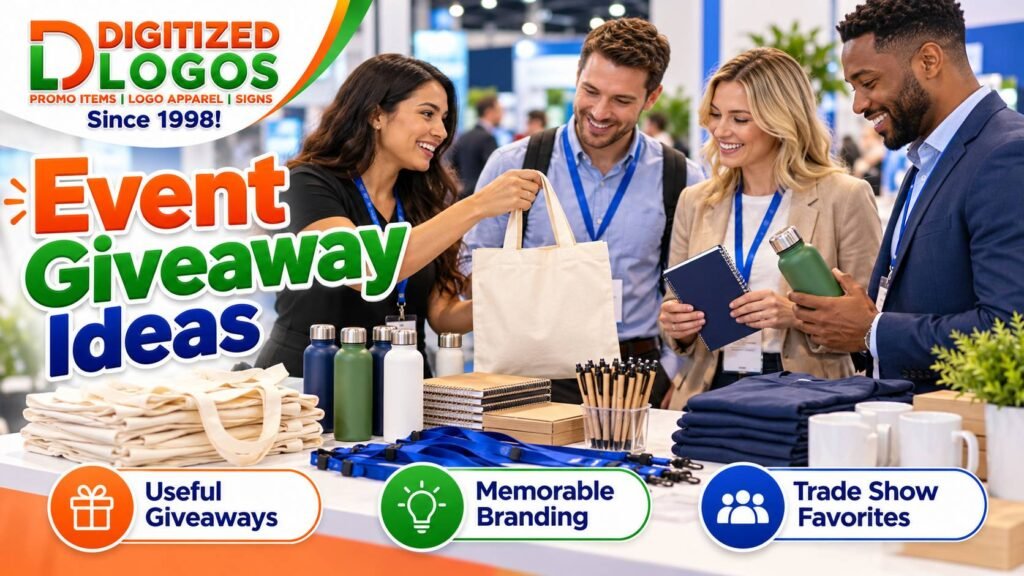
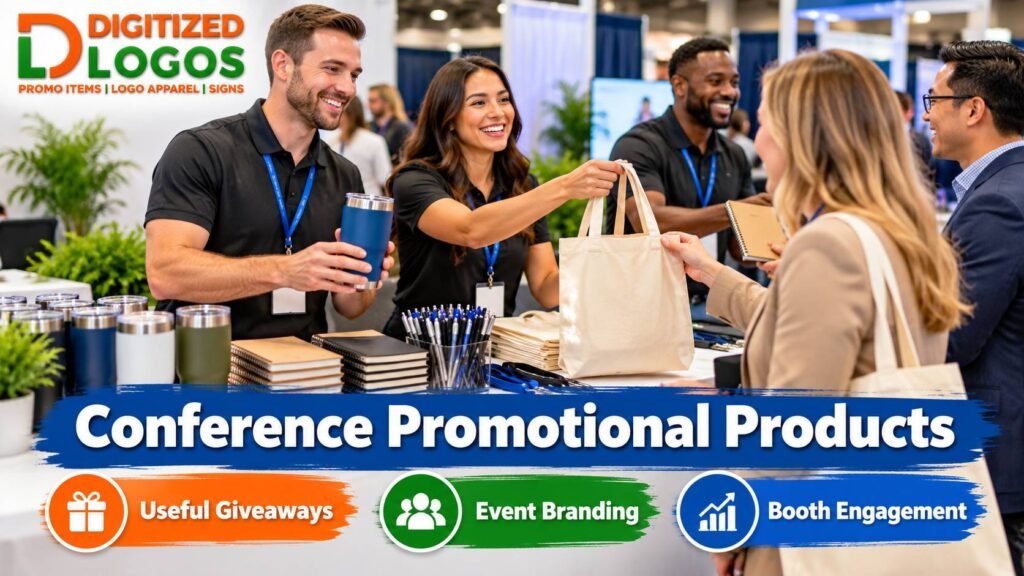
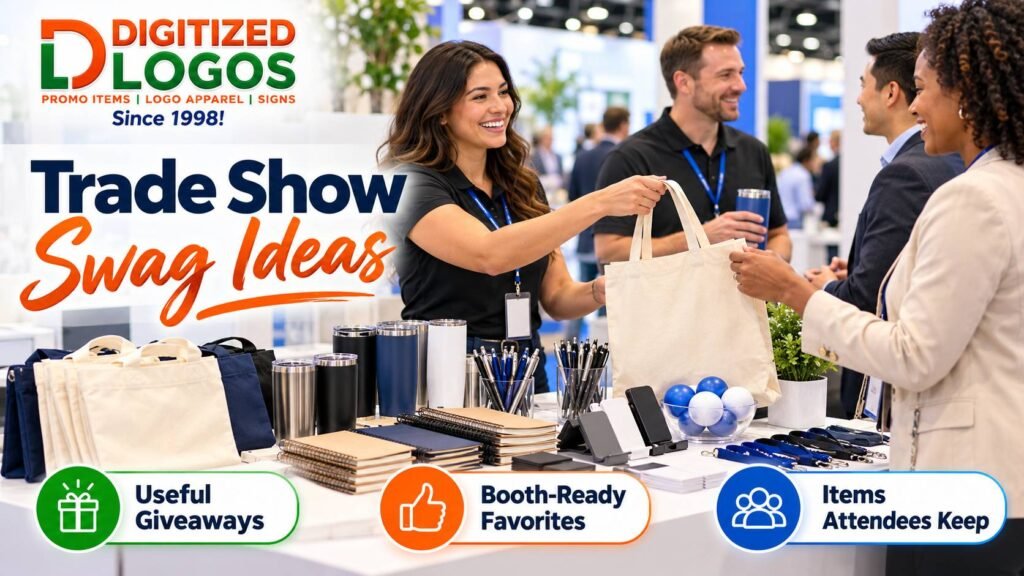
Event promotional products are customized items distributed at business events to promote an organization, communicate its identity, support attendee engagement, or create a lasting reminder of an event. Common examples include branded tote bags, reusable water bottles, notebooks, pens, T-shirts, lanyards, and technology accessories.
Unlike printed advertising that attendees may discard, useful promotional merchandise can remain part of someone’s routine. However, that continued exposure depends on whether recipients genuinely value and use the product.
The most effective merchandise choices typically reflect three priorities: the intended audience, the event’s purpose, and the practical value of the item.
Quick Answer: Which Promotional Products Work Best for Events?
The best promotional products for events are practical, appropriate for the audience, easy to distribute, and consistent with the brand’s identity. Reusable drinkware, tote bags, notebooks, and pens are versatile options, while branded apparel, technology accessories, and curated gift sets can suit more targeted engagement programs.
For large conferences, lightweight products are often easier to distribute. For executive meetings or VIP experiences, fewer items with stronger perceived value may be more appropriate.
No single promotional product is ideal for every event. Selection should begin with the recipient and the action the business wants to encourage.
Popular Event Promotional Products for Business Marketing
1. Custom Tote Bags and Reusable Shopping Bags
Branded tote bags are useful for conferences, trade shows, seminars, recruitment events, and community programs. Attendees can carry brochures, samples, notebooks, and other materials collected throughout an event.
Canvas, cotton, polyester, and nonwoven tote bags offer different combinations of appearance, structure, durability, and cost. The appropriate material depends on the intended use and the available budget.
For stronger visual presentation, consider the placement of the company logo, handle construction, bag dimensions, and decoration area. A large graphic may require a different printing technique than a small, single-color logo.
2. Custom Water Bottles and Drinkware
Reusable drinkware offers a practical branding opportunity for corporate gatherings, wellness events, outdoor programs, and employee appreciation activities.
Potential options include insulated tumblers, stainless steel bottles, reusable plastic bottles, and travel mugs. Buyers should evaluate capacity, lid design, portability, material, and the suitability of the decoration method.
For an outdoor event, a lightweight water bottle may be more convenient. For a professional appreciation gift, an insulated tumbler may offer a different presentation and user experience.
3. Branded T-Shirts, Polo Shirts, and Event Apparel
Custom apparel can serve two purposes at an event: identifying the organizing team and providing attendees with a wearable reminder of the brand.
Promotional T-shirts work well for volunteer programs, employee celebrations, community events, and product launches. Custom polo shirts can provide a coordinated, professional appearance for trade show representatives, hospitality teams, and corporate event staff.
When selecting event apparel, consider fabric composition, fit, sizing distribution, decoration method, care requirements, and wearing conditions.
Dye sublimation may be suitable for polyester-based garments requiring vibrant, detailed graphics. Embroidery can be appropriate for smaller logos on professional polos, while screen printing and heat transfers may suit other artwork, fabrics, and quantities.
Decoration suitability should always be confirmed for the specific garment.
4. Custom Notebooks, Pens, and Writing Accessories
Notebooks and pens remain practical choices for training seminars, educational conferences, workshops, and business meetings.
They are particularly relevant when attendees need to capture information, take notes, or complete event activities. Instead of selecting a product based entirely on price, evaluate writing comfort, notebook size, paper quality, and branding placement.
A coordinated notebook-and-pen set can also create a more unified presentation for onboarding events and professional development programs.
5. Promotional Technology Accessories
Technology-related merchandise can appeal to audiences who regularly use smartphones, laptops, and other digital devices.
Options include cable organizers, charging accessories, phone stands, webcam covers, and other desk-friendly products.
Technology products require additional purchasing attention. Compatibility, electrical safety, product specifications, certification claims, and supplier documentation should be reviewed before an order is approved.
A low-cost accessory that does not work reliably may create a less favorable impression than a simpler, well-made product.
6. Custom Lanyards and Badge Accessories
Conferences, conventions, training programs, and employee events often require badges or identification accessories.
Customized lanyards can support event identification while reinforcing brand colors, sponsor names, or event themes. Material, width, attachment type, breakaway features, and imprint visibility should influence product selection.
Lanyards also demonstrate why merchandise should be selected around a real event requirement rather than distributed solely as an advertising item.
7. Premium Executive and VIP Event Gifts
Premium gifts are often more appropriate for small, targeted audiences than for unrestricted booth distribution.
Examples include premium drinkware, branded jackets, business accessories, curated gift sets, and selected technology products.
For executive audiences, subtle branding and product quality may be more important than maximizing the size of the logo. Packaging and presentation should support the overall experience without unnecessarily increasing fulfillment costs.
How to Choose Branded Event Giveaways for Different Occasions
Effective branded event giveaways should match the setting in which they are distributed. A trade show, internal employee gathering, and executive conference may require completely different merchandise strategies.
Trade Shows and Industry Expos
Trade show attendees often visit multiple booths and collect promotional materials throughout the day. Compact, lightweight, useful products can make distribution easier and reduce the burden of carrying merchandise.
Suitable categories may include tote bags, pens, small notebooks, drinkware, and practical desk accessories.
For higher-value prospects, consider reserving a separate gift for scheduled meetings rather than distributing premium merchandise to every visitor.
Corporate Conferences and Seminars
Business conferences may benefit from coordinated welcome kits containing event materials, notebooks, writing accessories, and other useful attendee items.
When merchandise is prepared in advance, planners can create a more consistent arrival experience and simplify on-site distribution.
Employee Appreciation and Company Events
Employee-focused merchandise should reflect the organization and provide something employees would actually enjoy using.
Branded polo shirts, jackets, tumblers, bags, and selected lifestyle products can suit company celebrations, recognition programs, and team activities.
For wearable merchandise, size collection and distribution planning are particularly important.
Product Launches and Promotional Campaigns
A product launch may call for merchandise with a stronger creative connection to the campaign.
Custom apparel, promotional accessories, and coordinated product packaging can reinforce campaign colors and messaging. The objective should be to make the merchandise recognizable without sacrificing usefulness.
Community and Outdoor Events
Outdoor promotions may require merchandise that is easy to carry and appropriate for the expected conditions.
Drawstring bags, reusable bottles, caps, and lightweight apparel are possible choices, depending on the audience and event format.
How Customization Makes Promotional Merchandise More Effective
Customization turns a standard product into a branded communication tool. However, decoration methods differ in appearance, material compatibility, production requirements, and cost.
Screen Printing
Screen printing is commonly used for apparel and selected promotional merchandise. It can be an economical option for suitable designs and order quantities, although setup requirements and the number of ink colors may affect pricing.
Embroidery
Embroidery creates a stitched design commonly used on polo shirts, caps, jackets, and other textile products.
Small lettering, intricate details, and delicate gradients may require artwork adjustments. The garment’s construction and embroidery location also affect the finished result.
Dye Sublimation
Dye sublimation uses heat to transfer specialized dyes into compatible surfaces. It is particularly relevant for polyester apparel and specially coated promotional products.
For suitable applications, the process can reproduce detailed, full-color artwork, making it useful for branded event jerseys, promotional apparel, selected fabric displays, and other compatible merchandise.
Because the process depends on material compatibility, it is not suitable for every fabric or promotional item. Polyester content, product coating, base color, and print construction should be reviewed before production.
Heat Transfer and Digital Decoration
Heat transfer techniques can reproduce multicolor artwork on compatible products. Available methods vary by material and supplier, and each has its own requirements for artwork, application, and care.
For detailed graphics, confirm whether the product can support the design without compromising appearance or durability.
Laser Engraving
Laser engraving is used on certain metal, wood, and other compatible surfaces. It is often considered for drinkware, executive accessories, and professional gifts.
The resulting appearance depends on the material and finish. Buyers should not assume that laser engraving will reproduce full-color branding.
Behind the Scenes: Why Artwork Preparation Matters
One of the most common sources of promotional merchandise production problems is artwork that has not been prepared for the selected product and decoration method.
A logo that looks sharp on a computer screen may not reproduce clearly when printed at a small size. Thin lettering, gradients, fine lines, and low-resolution files can create production challenges.
Before approving an order, request confirmation of the following:
- Accepted artwork formats and resolution requirements.
- Maximum imprint dimensions and safe printing areas.
- Logo placement and orientation.
- Color requirements, including any applicable Pantone references.
- Decoration method and material compatibility.
- Proof approval procedures and production limitations.
For instance, a full-color artwork file may be suitable for a sublimated polyester shirt but need adjustments for embroidery on a polo. Maintaining the same brand identity across these products may require different production files rather than a single identical artwork setup.
A digital proof is valuable for confirming layout and spelling, but it may not reproduce the exact physical color, texture, or fit of a finished product. Where color accuracy or construction is especially important, ask about physical samples or preproduction samples.
How Much Do Event Promotional Products Cost?
The total cost of promotional merchandise depends on product selection, quantity, customization complexity, supplier setup charges, packaging, shipping, and any special fulfillment requirements.
A useful purchasing comparison considers the total delivered cost rather than the advertised unit price alone.
Example of a Promotional Merchandise Budget
Consider a hypothetical conference ordering 500 customized tote bags. Assume a unit price of $3.00, a $75 setup charge, and $125 for freight.
The calculation would be:
- 500 tote bags at $3.00 each: $1,500.
- Artwork or setup charge: $75.
- Estimated freight: $125.
- Total illustrative cost: $1,700.
- Illustrative delivered cost per bag: $3.40.
These figures are hypothetical and do not represent an actual Digitized Logos quotation. Taxes, event handling fees, and other applicable charges are excluded.
For accurate budgeting, request a written quotation based on the selected item, approved decoration specifications, required quantity, shipping destination, and event deadline.
Step-by-Step Guide to Planning an Event Promotional Product Order
A structured purchasing process helps reduce uncertainty, particularly when merchandise must arrive before a fixed event date.
- Define the event objective. Decide whether the merchandise will support brand awareness, attendee engagement, employee identification, relationship building, or customer appreciation.
- Identify the recipients. Consider audience demographics, professional interests, expected attendance, and how recipients are likely to use the products.
- Establish a realistic budget. Include customization, setup charges, packing, freight, taxes where applicable, and any event-site receiving fees.
- Shortlist appropriate products. Compare usefulness, visual presentation, portability, decoration options, and product quality.
- Prepare and review artwork. Confirm brand colors, imprint dimensions, logo placement, file formats, and decoration compatibility.
- Request pricing and production confirmation. Verify minimum order quantities, inventory, proof requirements, production schedules, and shipping arrangements.
- Approve the final proof. Review all artwork and order details before authorizing production.
- Coordinate delivery and distribution. Confirm the receiving address, event deadlines, shipment tracking, and who will manage merchandise on-site.
For events with multiple destinations or recipients, the shipping and distribution plan should be developed before the order is placed.
When Should You Order Promotional Products Before an Event?
Place orders early enough to accommodate product selection, artwork preparation, proof approval, production, shipping, and unexpected delays. There is no universal production timeline because customization methods, suppliers, inventory, and order quantities vary.
Custom apparel with complex decoration may require a different schedule than stock promotional items with a simple logo imprint.
Buyers should distinguish between production time and total delivery time. A supplier’s quoted production period may begin only after artwork approval and may not include transportation or event-site processing.
For time-sensitive orders, confirm the required in-hand date in writing and discuss alternatives if the preferred item cannot meet the schedule.
Two Practical Examples of Event Merchandise Planning
Example 1: Healthcare Company Attending an Industry Conference
Consider a hypothetical healthcare technology business exhibiting at a professional conference. The company expects substantial booth traffic but wants to reserve a portion of its budget for meaningful conversations with prospective customers.
A practical approach could combine affordable writing accessories for general visitors with higher-value branded notebooks or drinkware for qualified prospects attending scheduled demonstrations.
This creates different merchandise experiences without requiring the business to distribute expensive gifts to every attendee.
The company would also need to review the event organizer’s rules and any relevant corporate gift or compliance policies before distribution.
Example 2: Hospitality Group Hosting a Multi-Location Employee Event
Imagine a hypothetical restaurant group preparing a recognition event for employees from several properties.
Custom polo shirts featuring coordinated branding could provide a consistent team appearance, while branded tumblers or tote bags could serve as appreciation gifts.
The main operational challenges would include collecting apparel sizes, confirming brand consistency, managing quantities for each location, and coordinating delivery.
Maintaining approved artwork specifications and a centralized merchandise list could also simplify future reorders.
How to Measure the Value of Event Promotional Products
Promotional merchandise should be evaluated against the purpose of the event rather than judged only by the number of items distributed.
For brand awareness campaigns, distribution volume and recipient engagement may be useful indicators. For lead-generation events, merchandise may support conversations, but it should not automatically receive credit for every resulting sale.
Useful measurement approaches include:
- Distribution rate: Compare the number of products distributed with the quantity purchased.
- Cost per distributed item: Divide the total delivered merchandise cost by the number of units actually distributed.
- Engagement: Record meaningful booth conversations, demonstrations, or meetings associated with the campaign.
- Lead quality: Evaluate whether event interactions generated relevant, permission-based business inquiries.
- Waste and remaining inventory: Track merchandise left unused after the event.
- Recipient feedback: Gather observations about product usefulness, quality, and appeal.
For example, a branded item distributed during a product demonstration may contribute to the attendee experience, but its independent effect on a future purchasing decision can be difficult to isolate.
Businesses should avoid treating estimated impressions or potential brand exposure as guaranteed financial returns.
Common Mistakes to Avoid When Ordering Event Giveaways
Choosing Products Based Only on Price
The least expensive product is not necessarily the most economical if recipients are unlikely to use it. Compare practical usefulness, quality, and total distribution costs.
Ordering Without Checking Product Specifications
Two products that appear similar in a catalog may differ in material, size, finish, construction, or customization area. Review relevant specifications before purchase.
Overlooking Artwork Limitations
A logo with fine details may require adjustments for embroidery, engraving, or small imprint areas. Confirm decoration compatibility during product selection.
Waiting Until the Event Is Too Close
Late orders reduce flexibility when items are unavailable, proof revisions are needed, or shipping schedules change.
Ignoring Distribution Logistics
Event venues may have designated receiving procedures, shipping deadlines, material-handling charges, or restrictions on deliveries. Confirm these requirements directly with the venue or organizer.
Ordering More Merchandise Than Necessary
Excess inventory ties up budget and can result in waste, particularly when products contain event-specific dates or messaging.
Estimate demand using attendance expectations, distribution strategy, and any planned reserve quantity.
What to Look for in an Event Promotional Products Supplier
Choosing a supplier involves more than comparing catalog prices. A useful vendor relationship should provide clarity around customization, product specifications, order requirements, and delivery expectations.
When evaluating a promotional merchandise provider, consider whether it can:
- Recommend products suited to the event audience and budget.
- Explain available decoration methods and their limitations.
- Provide clear artwork and proof approval requirements.
- Confirm order minimums and pricing before production.
- Communicate inventory and scheduling constraints.
- Coordinate packaging and shipping requirements.
- Support consistent branding across multiple merchandise types.
- Help organize repeat orders or recurring merchandise needs.
Businesses purchasing products for several events may also benefit from standardized artwork files, approved product selections, and documented ordering procedures.
Explore Event Promotional Products With Digitized Logos
Digitized Logos provides promotional merchandise and branded apparel solutions for business customers, including products suitable for corporate events, conferences, marketing campaigns, and employee programs.
Companies exploring event promotional products can review customizable merchandise and consider options based on their audience, branding requirements, budget, and purchasing schedule.
Digitized Logos also offers dye sublimation capabilities for suitable custom products, providing an option for organizations interested in detailed, full-color graphics on compatible merchandise.
For a productive supplier discussion, prepare your event date, estimated quantity, target budget, preferred products, shipping destination, and available brand artwork.
Frequently Asked Questions About Event Promotional Products
What are the most useful promotional giveaways for trade shows?
Useful trade show giveaways often include tote bags, pens, notebooks, reusable drinkware, and compact desk accessories. The right choice depends on the event audience, expected distribution volume, and portability. Products that address a genuine attendee need are generally more appropriate than merchandise selected solely for novelty.
Can event promotional products include full-color company logos?
Yes. Many promotional items support full-color decoration through compatible printing or transfer methods. Dye sublimation is another option for suitable polyester-based fabrics and specially coated surfaces. Available techniques, artwork requirements, and color reproduction vary by product, so decoration specifications should be confirmed before ordering.
Are promotional giveaways effective for generating business leads?
Promotional giveaways can help initiate conversations and create positive attendee experiences, but a product alone does not guarantee qualified leads. The strongest approach connects merchandise distribution with relevant discussions, demonstrations, or permission-based follow-up activities. Businesses should measure lead quality alongside distribution costs.
Is there a minimum order quantity for custom event merchandise?
Minimum order quantities vary by supplier, product, and decoration method. Some products may support relatively small customized orders, while others require larger quantities because of setup or manufacturing considerations. Buyers should confirm minimums, setup charges, and available quantity breaks for their selected merchandise.
How can businesses keep promotional merchandise consistent across multiple events?
Businesses can improve brand consistency by maintaining approved logo files, documented color references, standardized imprint specifications, and preferred product selections. Using consistent approval procedures and keeping records of previous orders can simplify future purchasing while reducing unnecessary artwork revisions and decoration differences.
Key Takeaways for Event Merchandise Buyers
- Choose promotional products based on audience needs, event goals, and practical usefulness.
- Evaluate total delivered cost, not just the advertised unit price.
- Match customization techniques to product materials and artwork requirements.
- Confirm artwork approval, production schedules, and shipping arrangements before placing an order.
- Measure merchandise performance through engagement, distribution efficiency, lead quality, and unused inventory.
Make Your Next Event More Memorable With the Right Promotional Products
Thoughtfully selected event promotional products can support meaningful business interactions while keeping an organization’s identity visible beyond the event itself. The goal is not simply to distribute more merchandise. It is to choose products that recipients appreciate and that serve a clear business purpose.
From custom apparel and branded drinkware to practical giveaways and coordinated merchandise programs, Digitized Logos helps businesses explore products that align with their branding and event requirements.
Review available merchandise, compare customization options, and discuss your event needs before committing to an order.
Contact Digitized Logos to discuss promotional merchandise for your next event.
Phone: 301-963-3553
Email: info@DigitizedLogos.com